
Landsat has observed evidence of emperor penguins living on Smyley
Island in Antarctica as early as 1989. The TM (Thematic Mapper) on Landsat 4 captured this false-color image (left) of guano stains on fast ice on
December 24, 1989. The OLI (Operational Land Imager) on Landsat 8 captured a similar scene on December 10, 2025 (right).
The images combine observations of infrared, red, and green light to make it easier to distinguish the guano
stains. NASA Earth Observatory images by Michala Garrison.
With
their charming
waddles, heat-conserving huddles, and
tuxedo-like plumage, emperor penguins are among the world's most recognizable animals. Recent satellite
surveys estimate that hundreds of thousands of the flightless birds live in 66 colonies spread around Antarctica's inaccessible, frozen coastlines. But those numbers could fall in
the coming decades because emperor penguins rely on landfast (or fast) ice—a
type of sea ice attached to the shoreline—to breed, raise chicks, and molt.
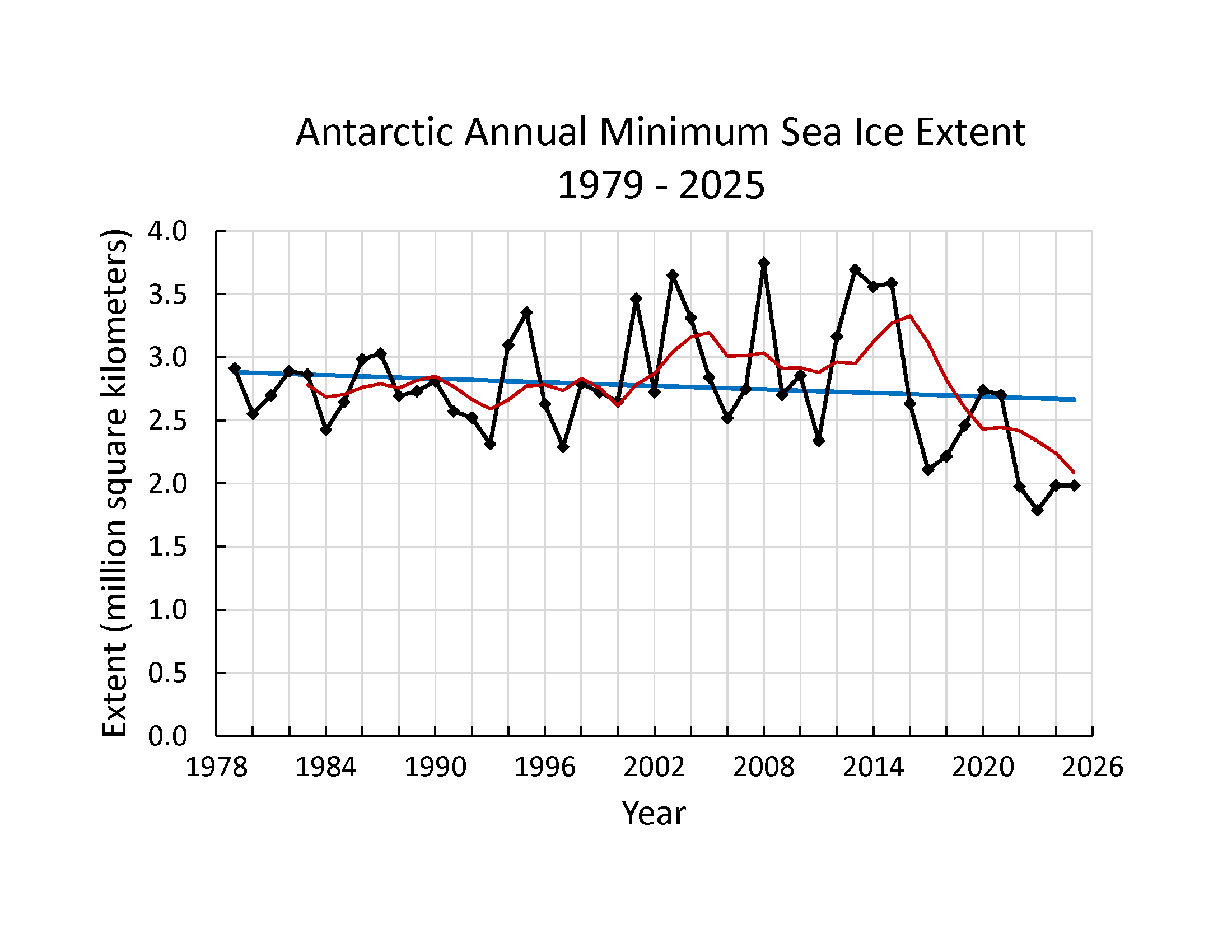
While Antarctic sea ice remained
relatively stable between the late 1970s and 2015, it has been declining since 2016, and climate projections suggest that trend will continue. How landfast ice is faring
remains poorly understood and is an
active area of study. However, one study suggests that it has declined in West Antarctica and the Weddell
Sea in recent decades even as it has trended upward in the Bellingshausen Sea
and East Antarctica.
Meanwhile, some models project that
emperor penguins could disappear by 2100 due to their habitats becoming inhospitable. The U.S. Fish &
Wildlife Service listed emperor penguins as threatened in 2022, and the International Union for Conservation of Nature classified them as endangered in 2026.
After Antarctic sea ice cover hit a record low in 2022, British Antarctic
Survey researchers reported "catastrophic" breeding failures among Bellingshausen Sea colonies. However, new
research, based on decades of observations from NASA-USGS Landsat satellites, offers some hope,
underscoring that many colonies have persisted for decades and that emperor
penguins may be more flexible about where they breed than previously thought.
Except for a few well-studied colonies,
scientists have known little about how long many emperor penguin colonies have
existed, how their populations have changed, or how they have responded to past
disruptions in landfast sea ice.

Adult and juvenile emperor penguins congregate on sea
ice in Antarctica.
Michael Van Woert, NOAA NESDIS,
ORA
"There's
little baseline information for what's 'normal' for most of these
colonies," said Michelle LaRue, a wildlife ecologist at the University of
Canterbury. That's made projecting future population levels a challenge.
Two new studies published in 2026 used
decades of Landsat observations to start filling gaps in understanding. Landsat
cannot resolve individual penguins, but researchers identify colonies from the guano stains that accumulate where
thousands of birds congregate on the ice.
Using this technique, researchers at the
University of Freiburg found that 18 colonies predate their initial
identification by an average of 17 years. Because Landsat has imaged Antarctica
continuously since the early 1980s, it provides one of the few systematic
long-term records of remote penguin colonies.
Among the oldest colonies studied was
the roughly 6,000-bird Smyley Island colony in the Bellingshausen Sea, which
dates to at least 1989, two decades earlier than previously known. Other
colonies that predated their earliest known presence by 20 or more years
included those at Barrier Bay, Brownson, Luitpold Coast, Ragnhild, Smith, and Verdi Inlet.
Scientists have watched the Smyley
Island colony closely in recent years because it is among the colonies that may
have suffered a total breeding failure in 2022. Satellite images captured that year show the colony
splitting up, with some penguins moving onto a large iceberg grounded near the
coast.
Despite persistently low sea-ice
conditions since then, the colony has continued to appear in satellite imagery,
generally establishing itself near icebergs along the edge of the ice shelf.
The image above on the right shows the colony in December 2025, the most recent
month Landsat has observed the colony.
"We're seeing a degree of
resilience in the Smyley Island colony," LaRue said. "They seem to be
doing okay now, and we will continue to monitor them to learn more about their
behaviors.” The colony's persistence underscores that one bad breeding
year—even a total failure—doesn't mean the end of a colony. Blizzards and
predators can lead to bad years with very low chick survival rates as well, she
added. "It's when we start to see frequent breeding failures year after
year that the birds won't be able to keep up, and it starts to be a problem for
a colony."

Landsat 8 captured an image of the SANAE colony with a
guano trail leading from rift ice to the ice shelf on January 23, 2018 (left).
On January 4, 2023, the birds had returned to their original fast ice area
(right). The images combine observations of infrared,
red, and green light to make it easier to distinguish the guano stains.
NASA Earth Observatory/Michala Garrison
A second study, led by Grant Macdonald, a remote
sensing scientist at Durham University, found further evidence of behavioral
flexibility. Macdonald and colleagues analyzed nearly 40 years of observations
from Landsat, the ASTER (Advanced Spaceborne Thermal
Emission and Reflection Radiometer) on NASA’s Terra satellite, and other sources for
three colonies disrupted by iceberg calving or early sea ice breakup. They
found that penguins of the Mertz and SANAE colonies responded by temporarily
shifting to nearby icebergs, embayments, or ice shelves before returning to
their former breeding sites.
Landsat first imaged the SANAE colony in
1984 on fast ice in a sheltered bay in the Queen Maud Land region in East
Antarctica. After a major calving event in 2011 exposed the fast ice to more
punishing winds, the colony relocated to rift ice in an embayment 11 kilometers
(7 miles) to the south. The move proved temporary. Part of the group moved to
another nearby site, and part of it returned to the original breeding location
in 2016.
Yet in the 2016–2017 breeding season,
the returnees did something unexpected. Despite the presence of stable fast
ice, they trekked onto the ice shelf and huddled and bred there. In the Landsat
image above, a winding guano-stained trail traces the penguins' route onto the
ice shelf. By 2022, after roughly a decade of wandering and splitting between
sites, the entire colony had returned to its original breeding ground on the
fast ice, where it has bred each year since.
At the third colony the researchers
studied, the Astrid colony on the Vigridisen Ice Shelf, the birds kept
returning to their original breeding location even after a major calving event
in 2006. That's likely because some fast ice remained and nearby icebergs
provided some shelter. The guano stains indicate that the colony did, however,
sometimes spend time on a nearby ice shelf toward the end of the breeding
season both before and after the calving event.
Indeed, moving and sometimes breeding on
alternative surfaces such as ice shelves, icebergs, or rift ice may be
"more common and feasible than previously thought," Macdonald said,
perhaps because some sites offer better shelter from wind. This willingness to
move may represent a "useful adaptation" as ocean temperatures warm
and sea ice declines, he added, though he cautioned that behavioral flexibility
alone won't necessarily offset the long-term effects of continued sea-ice loss.
"We have so much more to learn
about emperor penguins," added LaRue. "These colonies are so remote
and difficult to access that satellites—especially government satellites with
easily accessible data—are going to be absolutely invaluable to understanding
what the future will bring for them."
NASA Earth Observatory images by Michala Garrison, using Landsat data from the U.S. Geological Survey. Photo by Michael Van Woert (NOAA NESDIS, ORA). Story by Adam Voiland.
Source: A Changing World for Emperor Penguins - NASA Science

No comments:
Post a Comment