
Imagine if Earth were much, much closer to the Sun. So close that an entire year lasts only a few hours. So close that gravity has locked one hemisphere in permanent searing daylight and the other in endless darkness. So close that the oceans boil away, rocks begin to melt, and the clouds rain lava.
While
nothing of the sort exists in our own solar system, planets like this—rocky,
roughly Earth-sized, extremely hot and close to their stars—are not uncommon in
the Milky Way galaxy.
What are the surfaces and atmospheres of these planets really like? NASA’s James Webb Space Telescope is about to provide some answers.
With its mirror segments beautifully aligned and its scientific instruments
undergoing calibration, NASA’s James Webb Space Telescope is just weeks away
from full operation. Soon after the first observations are revealed this
summer, Webb’s in-depth science will begin.
Among the investigations planned for the first year are studies of two hot
exoplanets classified as “super-Earths” for their size and rocky composition:
the lava-covered 55 Cancri e and the airless LHS 3844 b. Researchers will train
Webb’s high-precision spectrographs on these planets
with a view to understanding the geologic diversity of planets across the
galaxy, and the evolution of rocky planets like Earth.
Super-Hot Super-Earth 55
Cancri e
55 Cancri e orbits less than 1.5 million miles from its Sun-like star (one
twenty-fifth of the distance between Mercury and the Sun), completing one
circuit in less than 18 hours. With surface temperatures far above the melting
point of typical rock-forming minerals, the day side of the planet is thought
to be covered in oceans of lava.
Planets that orbit this close to their star are assumed to be tidally
locked, with one side facing the star at all times. As a result, the hottest
spot on the planet should be the one that faces the star most directly, and the
amount of heat coming from the day side should not change much over time.
But this doesn’t seem to be the case. Observations of 55 Cancri e from
NASA’s Spitzer Space Telescope suggest that the hottest region is offset from
the part that faces the star most directly, while the total amount of heat
detected from the day side does vary.
Does 55 Cancri e Have a
Thick Atmosphere?
One explanation for these observations is that the planet has a dynamic
atmosphere that moves heat around. “55 Cancri e could have a thick atmosphere
dominated by oxygen or nitrogen,” explained Renyu Hu of NASA’s Jet Propulsion
Laboratory in Southern California, who leads a team that will use Webb’s Near-Infrared
Camera (NIRCam) and Mid-Infrared
Instrument (MIRI) to capture the thermal emission
spectrum of the day side of the planet. “If it has an
atmosphere, [Webb] has the sensitivity and wavelength range to detect it and
determine what it is made of,” Hu added.
Or Is It Raining Lava in
the Evening on 55 Cancri e?
Another intriguing possibility, however, is that 55 Cancri e is not tidally
locked. Instead, it may be like Mercury, rotating three times for every two
orbits (what’s known as a 3:2 resonance). As a result, the planet would have a
day-night cycle.
“That could explain why the hottest part of the planet is shifted,”
explained Alexis Brandeker, a researcher from Stockholm University who leads
another team studying the planet. “Just like on Earth, it would take time for
the surface to heat up. The hottest time of the day would be in the afternoon,
not right at noon.”
Brandeker’s team plans to test this hypothesis using NIRCam to measure the
heat emitted from the lit side of 55 Cancri e during four different orbits. If
the planet has a 3:2 resonance, they will observe each hemisphere twice and
should be able to detect any difference between the hemispheres.
In this scenario, the surface would heat up, melt, and even vaporize during
the day, forming a very thin atmosphere that Webb could detect. In the evening,
the vapor would cool and condense to form droplets of lava that would rain back
to the surface, turning solid again as night falls.
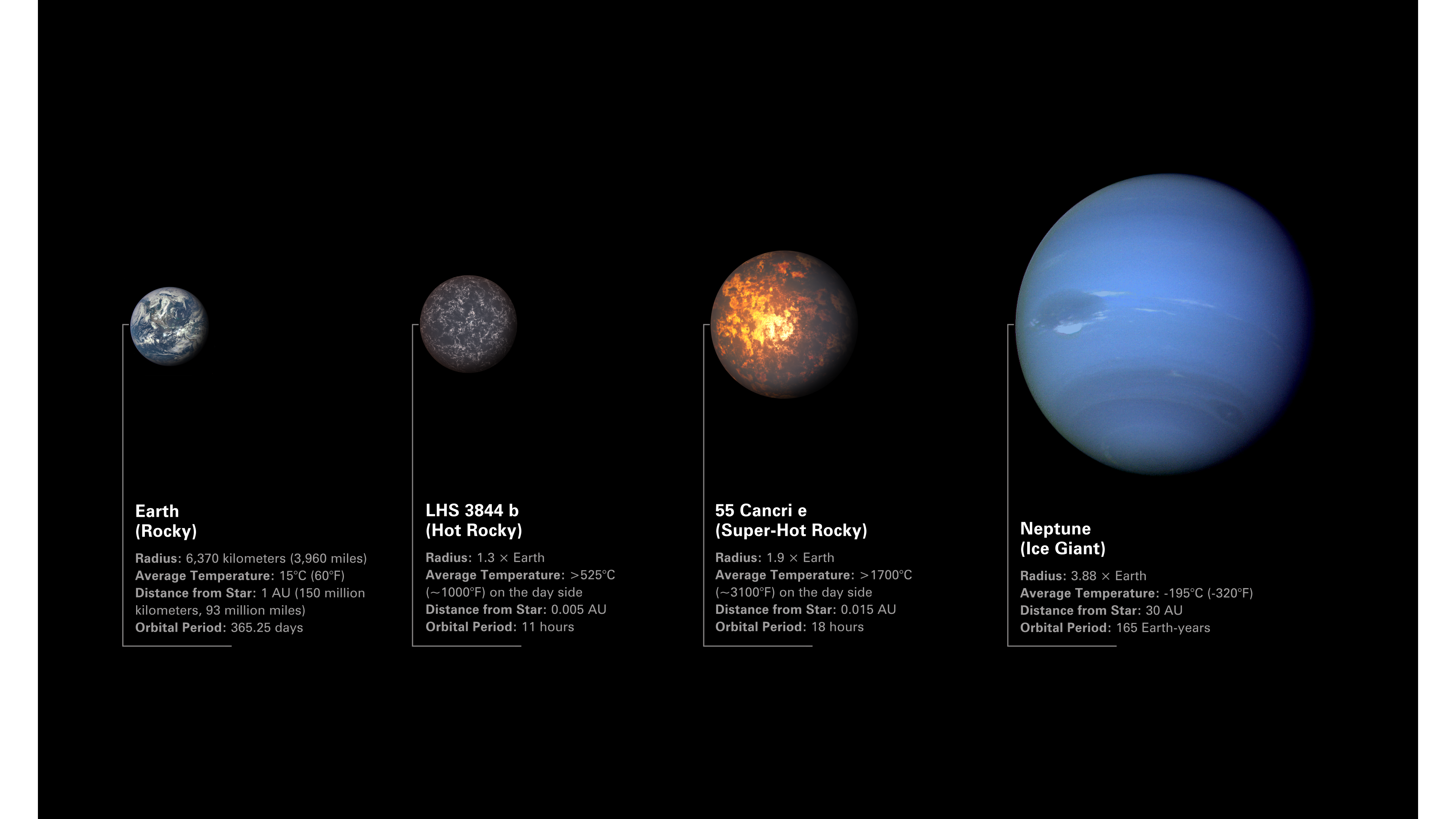
Illustration comparing rocky exoplanets LHS 3844 b and 55 Cancri e to Earth and Neptune. Both 55 Cancri e and LHS 3844 b are between Earth and Neptune in terms of size and mass, but they are more similar to Earth in terms of composition. The planets are arranged from left to right in order of increasing radius. Credits: ILLUSTRATION: NASA, ESA, CSA, Dani Player (STScI)
Somewhat Cooler
Super-Earth LHS 3844 b
While 55 Cancri e will provide insight into the exotic geology of a world
covered in lava, LHS 3844 b affords a unique opportunity to analyze the solid
rock on an exoplanet surface.
Like 55 Cancri e, LHS 3844 b orbits extremely close to its star, completing
one revolution in 11 hours. However, because its star is relatively small and
cool, the planet is not hot enough for the surface to be molten. Additionally,
Spitzer observations indicate that the planet is very unlikely to have a
substantial atmosphere.
What Is the Surface of
LHS 3844 b Made of?
While we won’t be able to image the surface of LHS 3844 b directly with
Webb, the lack of an obscuring atmosphere makes it possible to study the
surface with spectroscopy.
“It turns out that different types of rock have different spectra,”
explained Laura Kreidberg at the Max Planck Institute for Astronomy. “You can
see with your eyes that granite is lighter in color than basalt. There are
similar differences in the infrared light that rocks give off.”
Kreidberg’s team will use MIRI to capture the thermal emission spectrum of
the day side of LHS 3844 b, and then compare it to spectra of known rocks, like
basalt and granite, to determine its composition. If the planet is volcanically
active, the spectrum could also reveal the presence of trace amounts of
volcanic gases.
The importance of these observations goes far beyond just two of the more
than 5,000 confirmed exoplanets in the galaxy. “They will give us fantastic new
perspectives on Earth-like planets in general, helping us learn what the early
Earth might have been like when it was hot like these planets are today,” said
Kreidberg.
These observations of 55 Cancri e and LHS 3844 b will be conducted as part
of Webb’s Cycle 1 General
Observers program. General Observers programs were
competitively selected using a dual-anonymous review system, the same system
used to allocate time on Hubble.
The James Webb Space Telescope is the world's premier space science
observatory. Webb will solve mysteries in our solar system, look beyond to
distant worlds around other stars, and probe the mysterious structures and
origins of our universe and our place in it. Webb is an international program
led by NASA with its partners, ESA (European Space Agency) and the Canadian Space
Agency.
Banner Image: Illustration showing what exoplanet
55 Cancri e could look like, based on current understanding of the planet. 55
Cancri e is a rocky planet with a diameter almost twice that of Earth orbiting
just 0.015 astronomical units from its Sun-like star. Because of its tight
orbit, the planet is extremely hot, with dayside temperatures reaching 4,400
degrees Fahrenheit (about 2,400 degrees Celsius). Artwork
Credit: NASA, ESA, CSA, Dani Player (STScI)
Source: Geology
from 50 Light-Years: Webb Gets Ready to Study Rocky Worlds | NASA

