Friday, March 28, 2025

NASA, NSIDC Scientists Say Arctic Winter Sea Ice at Record Low - EARTH


Ice cover ebbs and flows through the seasons in the Arctic (left) and the Antarctic (right). Overall, ice cover has declined since scientists started tracking it half a century ago. Download this visualization from NASA’s Scientific Visualization Studio: https://svs.gsfc.nasa.gov/5099

Trent Schindler/NASA’s Scientific Visualization Studio

Winter sea ice cover in the Arctic was the lowest it’s ever been at its annual peak on March 22, 2025, according to NASA and the National Snow and Ice Data Center (NSIDC) at the University of Colorado, Boulder. At 5.53 million square miles (14.33 million square kilometers), the maximum extent fell below the prior low of 5.56 million square miles (14.41 million square kilometers) in 2017. 

In the dark and cold of winter, sea ice forms and spreads across Arctic seas. But in recent years, less new ice has been forming, and less multi-year ice has accumulated. This winter continued a downward trend scientists have observed over the past several decades. This year’s peak ice cover was 510,000 square miles (1.32 million square kilometers) below the average levels between 1981 and 2010. 

In 2025, summer ice in the Antarctic retreated to 764,000 square miles (1.98 million square kilometers) on March 1, tying for the second lowest minimum extent ever recorded. That’s 30% below the 1.10 million square miles (2.84 million square kilometers) that was typical in the Antarctic prior to 2010. Sea ice extent is defined as the total area of the ocean with at least 15% ice concentration.

The reduction in ice in both polar regions has led to another milestone — the total amount of sea ice on the planet reached an all-time low. Globally, ice coverage in mid-February of this year declined by more than a million square miles (2.5 million square kilometers) from the average before 2010. Altogether, Earth is missing an area of sea ice large enough to cover the entire continental United States east of the Mississippi. 

“We’re going to come into this next summer season with less ice to begin with,” said Linette Boisvert, an ice scientist at NASA’s Goddard Space Flight Center in Greenbelt, Maryland. “It doesn’t bode well for the future.”

Observations since 1978 show that ice cover has declined at both poles, leading to a downward trend in the total ice cover over the entire planet. In February 2025, global ice fell to the smallest area ever recorded. Download this visualization from NASA's Scientific Visualization Studio: https://svs.gsfc.nasa.gov/5521

Mark Subbaro/NASA's Scientific Visualization Studio

Scientists primarily rely on satellites in the Defense Meteorological Satellite Program, which measure Earth’s radiation in the microwave range. This natural radiation is different for open water and for sea ice — with ice cover standing out brightly in microwave-based satellite images. Microwave scanners can also penetrate through cloud cover, allowing for daily global observations. The DMSP data are augmented with historical sources, including data collected between 1978 and 1985 with the Nimbus-7 satellite that was jointly operated by NASA and the National Oceanic and Atmospheric Administration. 

“It’s not yet clear whether the Southern Hemisphere has entered a new norm with perennially low ice or if the Antarctic is in a passing phase that will revert to prior levels in the years to come,” said Walt Meier, an ice scientist with NSIDC.

Credits: Charles Connell / NASA Goddard Space Flight Center

By James Riordon
NASA’s Earth Science News Team
 

Source: NASA, NSIDC Scientists Say Arctic Winter Sea Ice at Record Low - NASA

An evolving robotics encyclopedia characterizes robots based on their performance

The Robot Performance and Safety Test center and test setups for tacile robot performance being explained by Robin Kirschner. Credit: TUM-MIRMI, Dayana Ramirez.

Over the past decades, roboticists have introduced a wide range of systems with distinct body structures and varying capabilities. As the number of developed robots continuously grows, being able to easily learn about these many systems, their unique characteristics, differences and performance on specific tasks could prove highly valuable.

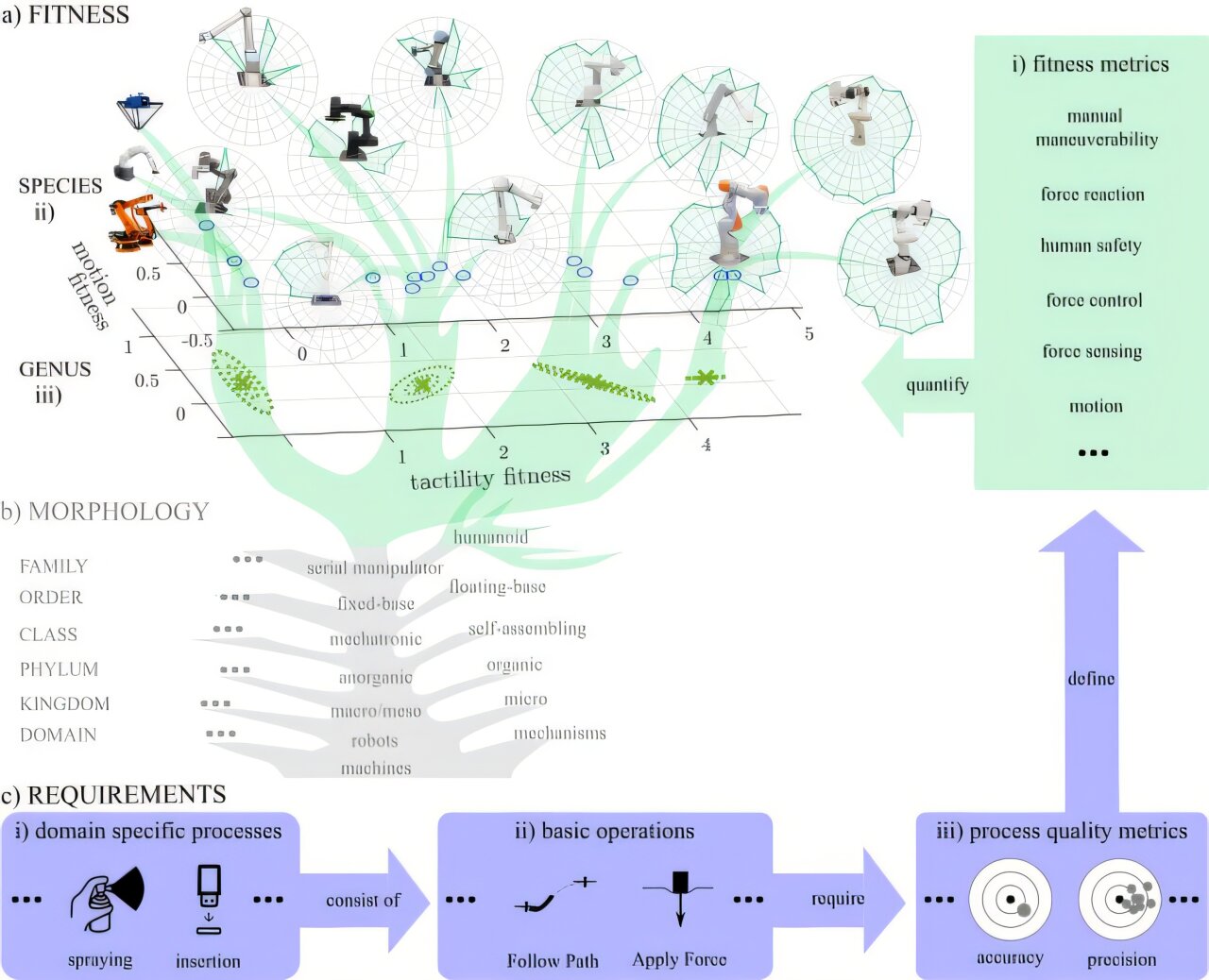
Researchers at Technical University of Munich (TUM) recently created the "Tree of Robots," a new encyclopedia that could make learning about existing robotic systems and comparing them significantly easier. Their robot encyclopedia, introduced in a paper published in Nature Machine Intelligence, categorizes robots based on their performance fitness on various tasks.

"The aspiration for intelligent robots that can understand their environment as we humans do, and execute tasks independently, has existed for ages," Robin Jeanne Kirschner, first author of the paper, told Tech Xplore.

"The active development of tactile robots—robots capable of understanding their surroundings through the sensation of touch—began approximately 20 years ago. This journey started with the creation of lightweight systems equipped with torque sensors in every joint. Since then, we have witnessed improved technology, better controllers, and new reaction schemes, which have enabled the development of systems proficient in executing tasks and perceiving the environment through touch." 

Core idea and concept of the tree of robots addressed in the study. Credit: Nature Machine Intelligence (2025). DOI: 10.1038/s42256-025-00995-y

Most standards and approaches for classifying robots introduced to date do not account for the ability of systems to adapt to their surroundings and successfully interact with nearby objects by touching them. This crucial capability influences both the safety of robots and their performance on specific tasks, spanning various real-world applications.

"The focus of system classification remains separated based on, e.g., individual mechanical properties, new controller features, and certifications remains based solely on the mechanical structure of sensing systems instead of their actual performance," said Kirschner. "This narrow approach often overlooks the interplay of components and the core purpose of a robotic device: to assist in executing tasks, which demands specific capabilities."

To overcome the limitations of existing robot classification methods, Kirschner and her colleagues started testing various existing systems, focusing on features that influence their safety, such as their ability to detect contact with other objects. Concurrently, they also conducted an in-depth analysis of robotics tasks, deriving multiple metrics that indicate the capabilities of robots beyond safety, for instance, impacting their ability to successfully execute tactile tasks and comfortably interact with humans.

"By testing multiple robot manipulators, we were then able to derive all these metrics and show that the tactility fitness of these systems significantly varies, calling for a proper classification and encyclopedia—the Tree of Robots," said Kirschner.

The tree of robots concept and first established grouping for industrial fixed based manipulators. Credit: Kirschner et al. (Nature Machine Intelligence, 2025).

"As a result, we established the AI Robot Performance and Safety Center—a dedicated laboratory equipped with advanced measurement devices to evaluate robot performance. With these resources, we aim to further grow the 'Tree of Robot,' an essential encyclopedia for the field of robotics."

The Tree of Robots encyclopedia is meant to be continuously updated over time, ultimately serving as a Wikipedia-like platform that contains information about robots and their capabilities. It includes a wide pool of information ranging from the robots' fundamental body structures to the motors and/or sensors they rely on and their resulting capabilities, specifically the sensitivity and reliability of their physical interactions (i.e., tactility fitness) and precision of their movements (i.e., motion fitness).

"While we began with analyzing and classifying existing stationary manipulators using fitness metrics we defined specifically based on for industrial applications, the encyclopedia must grow to encompass other robotic systems for service tasks, such as humanoids or mobile robots," explained Kirschner. "Its purpose is to efficiently guide both hardware and software development in robotics."

In contrast with many previously devised robot categorization approaches, the Tree of Robots encyclopedia clearly outlines the specialized capabilities of different robots. In addition, it groups robots into three main groups based on their tactility fitness, which indicates the extent to which they are suitable for completing specific tasks.

Metric test setups. Credit: Nature Machine Intelligence (2025). DOI: 10.1038/s42256-025-00995-y

"This fundamental insight should be integrated into application design, standardization efforts, and future robotics development," said Kirschner. "By aligning hardware and software components to achieve optimal performance for a given process—rather than designing processes to fit the system's constraints—we can advance robotics to new levels of efficiency and effectiveness."

The new encyclopedia developed by Kirschner and her colleagues could inform future research, for instance, by helping other computer scientists and roboticists to identify the best systems to test their algorithms. Meanwhile, the researchers plan to continue adding information to the Tree of Robots, including other robotic systems and other relevant metrics.

"We are now expanding our work in several directions," added Kirschner. "My focus is on linking these critical findings to ensure human safety in collaborations, emphasizing a robot's tactile capabilities. The goal is to achieve certifiably safe applications with tactile robotic systems. Alongside other teams, we are also exploring how to extend the tree of robots in other areas, such as systems designed for service and care tasks and including, e.g., humanoid systems." 

by Ingrid Fadelli , Tech Xplore

Source: An evolving robotics encyclopedia characterizes robots based on their performance